
High-Speed Bamboo Pulp Toilet Paper Production Line Set to Transform Sustainable Hygiene Manufacturing
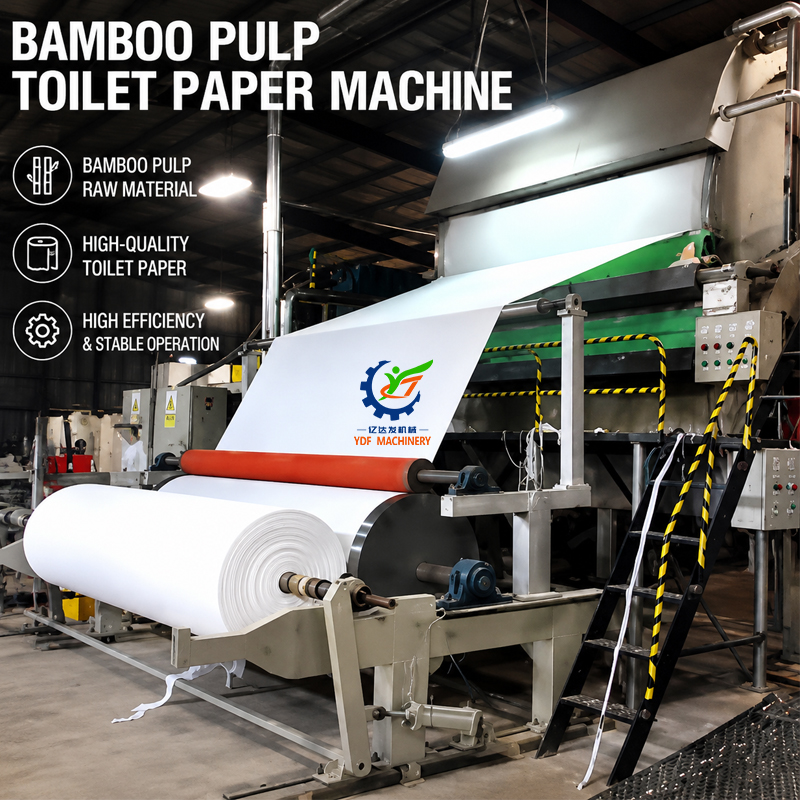
Industry’s latest breakthrough combines record production speeds with unprecedented environmental performance
A major advancement in sustainable consumer goods manufacturing has arrived with the launch of a new high-speed bamboo pulp toilet paper production line, designed to convert fast-growing bamboo into premium-quality tissue products with exceptional efficiency and minimal environmental impact. The system represents a significant step forward for an industry increasingly pivoting toward renewable raw materials.
The production line addresses what has long been a critical challenge in the tissue paper sector: processing bamboo’s fibrous, hollow structure at high speeds without compromising product quality. Unlike traditional hardwood sources that take decades to mature, bamboo grows up to one meter per day, requires no replanting after harvest, and consumes 30 percent less water than conventional timber plantations. These characteristics have positioned bamboo as a leading alternative to wood-based tissue feedstocks, yet the material’s unique properties have historically posed obstacles for high-speed paper conversion, including increased dust generation and uneven sheet formation.
Engineered for Performance and Sustainability
The newly developed production line incorporates multiple proprietary innovations engineered to overcome these processing hurdles. An adaptive crushing and refining unit employs a multi-stage mechanical system that uniformly breaks down bamboo’s dense lignin structure without over-shortening fibers, preserving natural fiber length for softer, stronger tissue products.
Energy efficiency has been a primary focus in the system’s design. Advanced thermo-compression technology integrated into the drying cylinders reduces steam consumption by 18 percent compared to conventional tissue production lines. A closed-loop filtration system recycles 96 percent of process water on-site, addressing one of the tissue manufacturing industry’s most pressing environmental concerns. Real-time artificial intelligence-driven profile control adjusts moisture, thickness, and winding tension automatically, reducing material waste by up to 12 percent.
Technical Specifications and Production Capacity
The production line is available with customizable configurations to meet diverse manufacturing requirements. Operating speeds reach 450 meters per minute, with trim widths ranging from 2,800 to 5,600 millimeters. The system accommodates basis weights from 13 to 25 grams per square meter, making it suitable for facial tissue, toilet paper, and kitchen towel production. Raw material compatibility includes 100 percent bamboo pulp as well as bamboo-wood blended furnishes.
Daily output capacity ranges from 60 to 90 metric tons, positioning the system as a solution for both mid-sized operators and large-scale industrial manufacturers. A modular zero-splice winding system automatically transfers rolls without stopping the production line—a critical capability for tissue converters operating under tight just-in-time delivery schedules.
Market Context and Industry Momentum
The launch comes at a pivotal moment for the tissue paper industry. Market analysts project that bamboo tissue production will grow at an annual rate of 9.7 percent through 2030, driven by bans on single-use plastics, rising demand for premium eco-labeled products in Europe and North America, and expanding bamboo supply chains across Southeast Asia and Latin America.
Early adopters of the new production line have reported a 22 percent reduction in production costs per ton compared to imported virgin wood pulp, while qualifying for carbon credits under verified carbon standard methodologies for bamboo cultivation.
The broader industry is responding to these market dynamics with significant capital investments. One major paper manufacturer recently announced a revised capital expenditure plan of approximately 25.5 million US dollars for its facility in central India, redirecting strategy toward tissue manufacturing with a focus on premium and sustainable products, including bamboo pulp-based grades. The project is scheduled for implementation by fiscal year 2027-28, with full operational capacity expected by fiscal year 2029-30, adding 23,400 tonnes per annum to the facility’s existing capacity.
In another development, a bamboo resources development company has completed installation of pulp production equipment for a 100,000-ton tissue paper project, which has now entered the commissioning phase. The company’s production capacity continues to expand, consuming nearly 1.4 million tons of bamboo raw materials annually.
A Complete Value Chain Enabler
Industry observers note that the new production line represents more than a piece of equipment—it functions as a complete value chain enabler, bridging the gap between renewable bamboo resources and everyday hygiene products. Modern bamboo tissue paper machines are designed with advanced automation systems that optimize every stage of the production process, from stock preparation and sheet formation to drying and winding. Key advantages include high-speed production capability, reduced machine downtime, consistent product quality, lower labor requirements, and improved operational efficiency.
The versatility of these production lines enables manufacturers to produce a wide range of products, including toilet tissue, facial tissue, napkins, kitchen towels, and jumbo tissue rolls, allowing mills to quickly respond to changing market demands and diversify their product portfolios.
Environmental and Economic Implications
The shift toward bamboo-based tissue production aligns with broader sustainability goals while delivering tangible economic benefits. Bamboo pulp production supports sustainable manufacturing practices, reduces environmental impact, and helps manufacturers meet customer expectations for eco-friendly products. The system’s energy-saving technologies—including optimized drying systems, efficient vacuum equipment, and intelligent process controls—help mills achieve reduced utility costs, improved energy efficiency, and better long-term profitability.
For tissue manufacturers, the ability to produce premium-quality products that meet international market standards opens access to higher-margin market segments. Uniform sheet formation, improved fiber utilization, better softness and bulk, enhanced tensile strength, and consistent roll quality are among the benefits delivered by modern bamboo tissue production lines.
Industry Perspective
A representative from the manufacturing team stated that bamboo is widely regarded as the future of sustainable hygiene, but only if it can be processed as reliably as wood. The new production line transforms bamboo from a challenging feedstock into a mainstream solution. It delivers the same softness, absorbency, and roll firmness consumers expect, while offering brands a genuine story of reforestation and carbon sequestration.
The system has been designed and deployed by a manufacturer with over 340 pulp and paper lines installed across 28 countries. A dedicated initiative focuses on converting underutilized bamboo forests into profitable, environmentally responsible tissue production assets.
Availability
The high-speed bamboo pulp toilet paper production line is now available for order, with deliveries scheduled for the fourth quarter of 2026. A virtual technical seminar for engineers and sustainability officers is planned to provide detailed technical briefings and implementation guidance. Live demonstrations are scheduled for industry exhibitions, offering manufacturers the opportunity to evaluate the system’s capabilities firsthand.

