
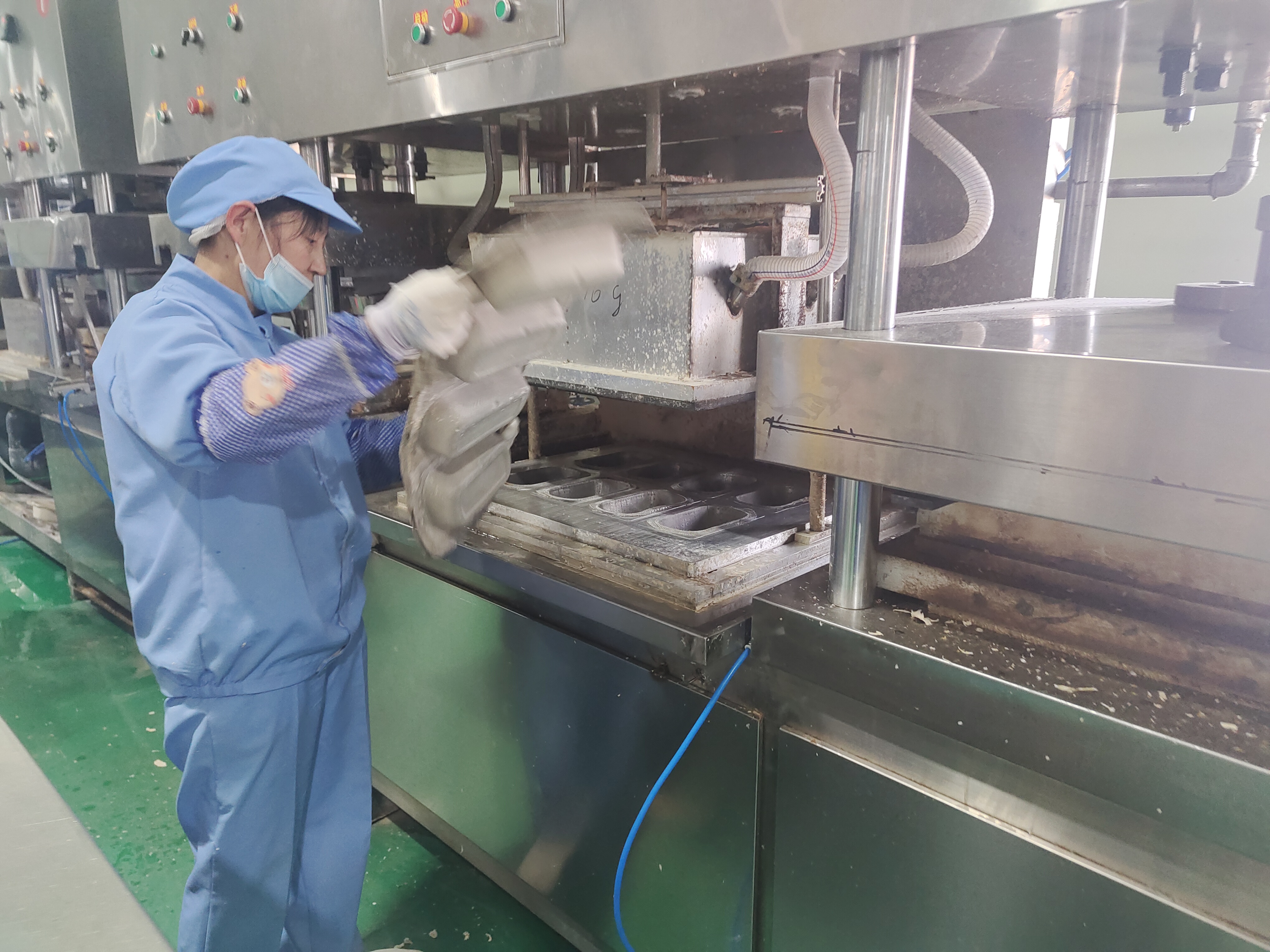
As global environmental awareness continues to increase, the demand for sustainable food packaging and disposable tableware is creating new opportunities for the molded pulp industry. Traditional plastic plates, bowls, and food containers are facing growing environmental concerns, encouraging manufacturers to explore renewable and biodegradable alternatives.
A Bagasse Pulp Molded Tableware Machine provides an efficient manufacturing solution by converting sugarcane bagasse into molded pulp products, including disposable plates, bowls, trays, and food containers.
Sugarcane bagasse is an agricultural by-product generated during sugar production. Instead of being discarded or underutilized, this fibrous material can be processed into pulp and used as a renewable raw material for molded tableware manufacturing.
For investors and packaging manufacturers looking to enter the eco-friendly tableware market, bagasse pulp molding technology offers an attractive opportunity to develop sustainable production capabilities.
A bagasse pulp molded tableware machine is an industrial production system designed to manufacture disposable tableware using sugarcane bagasse pulp.
The equipment combines pulp preparation, vacuum forming, hot pressing, drying, trimming, and finishing processes to produce molded products with different shapes, sizes, and thicknesses.
Depending on production requirements, the system can be configured with automatic or semi-automatic operation, multiple forming stations, customized molds, and integrated production equipment.
Typical finished products include:
Sugarcane bagasse disposable plates
Biodegradable food bowls
Molded pulp lunch boxes
Takeaway food containers
Disposable food trays
Customized molded pulp packaging
A complete bagasse pulp molded tableware production line generally consists of several important manufacturing stages.
Step 1: Raw Material Preparation
Sugarcane bagasse is collected, cleaned, and prepared for pulping. Proper raw material preparation helps improve pulp quality and production consistency.
Step 2: Pulping and Refining
The prepared bagasse is processed through a pulping system to separate fibers and produce suitable pulp. Refining and pulp treatment help achieve the required fiber characteristics for molding.
Step 3: Pulp Forming
The prepared pulp is transferred into the forming system. Through vacuum suction, fibers are deposited onto specially designed molds to create the initial shape of plates, bowls, or food containers.
Step 4: Hot Pressing and Drying
The molded products undergo hot pressing and drying to reduce moisture, improve structural strength, and achieve the required product appearance.
Step 5: Trimming and Finishing
Excess edges are removed to improve product dimensions and appearance. Additional finishing processes can be configured according to the final product requirements.
Step 6: Quality Inspection and Packaging
Finished products are inspected for shape, thickness, surface quality, and structural performance before being packaged for storage or transportation.
Sugarcane bagasse is a renewable agricultural by-product. Utilizing this material helps create additional value from agricultural resources and supports the development of alternative food packaging materials.
With customized molds, one production system can manufacture different types of molded pulp tableware, including plates, bowls, trays, and takeaway containers.
Modern bagasse pulp molding machines can integrate automatic forming, hot pressing, transfer, trimming, and stacking systems. Automation can reduce manual handling and improve production consistency.
Manufacturers can select equipment configurations according to product dimensions, daily output targets, factory space, and investment budgets.
Bagasse molded tableware is used in restaurants, catering businesses, takeaway food services, supermarkets, and food packaging distribution channels.
Bagasse pulp molded products are widely used in food service and packaging applications.
Restaurants and Catering: Disposable plates, bowls, and food containers for everyday food service.
Takeaway and Food Delivery: Molded pulp lunch boxes and takeaway packaging.
Supermarkets and Retail: Disposable tableware and food packaging products.
Hotels and Events: Convenient disposable tableware for catering and large gatherings.
Food Packaging Manufacturers: Customized molded pulp products for different commercial requirements.
Product performance depends on raw material quality, pulp formulation, molding technology, and any additional barrier treatment.
Selecting suitable equipment is an important decision for manufacturers planning to establish a molded pulp tableware factory.
Before purchasing a machine, investors should consider the following factors:
Production Capacity: Determine the required output based on market demand and business development plans.
Product Specifications: Confirm the dimensions, shapes, thickness, and types of tableware to be manufactured.
Raw Material Availability: Evaluate the local supply and quality of sugarcane bagasse.
Automation Level: Choose an appropriate automation configuration based on labor costs and production requirements.
Energy Consumption: Compare the energy requirements of forming, hot pressing, drying, and auxiliary systems.
Factory Layout: Consider the installation space required for pulp preparation, production equipment, storage, and packaging.
Technical Support: Evaluate equipment installation, operator training, spare parts availability, and after-sales service.
A properly configured production line can help manufacturers improve production management and build long-term competitiveness.
The transition toward sustainable packaging materials is creating opportunities for manufacturers of molded pulp products.
Food service companies, catering suppliers, packaging distributors, and environmentally conscious brands are exploring alternatives to conventional disposable plastic products.
Bagasse pulp molded tableware offers manufacturers an opportunity to utilize agricultural resources while developing products for different commercial markets.
For businesses planning to invest in this sector, choosing suitable equipment and developing a reliable production process are essential steps toward successful manufacturing.
Q1: What raw materials are used in a bagasse pulp molded tableware machine?
The primary raw material is sugarcane bagasse, a fibrous by-product of sugar production. Depending on the production formula, other pulp materials may also be incorporated.
Q2: What products can a bagasse pulp molding machine manufacture?
It can produce disposable plates, bowls, food trays, lunch boxes, takeaway containers, and other customized molded pulp products.
Q3: Is bagasse molded tableware biodegradable?
Bagasse-based tableware is generally biodegradable under suitable environmental conditions. Actual degradation performance depends on product composition, coatings, additives, and disposal conditions.
Q4: Can one machine produce different types of tableware?
Yes. With suitable interchangeable molds and compatible machine configurations, manufacturers can produce different shapes and sizes of molded pulp products.
Q5: What equipment is required for a complete production line?
A typical production line includes a pulp preparation system, forming machine, hot pressing equipment, drying system, trimming equipment, and auxiliary systems. The exact configuration depends on the production process.
Q6: How can I determine the investment cost of a bagasse pulp molded tableware production line?
The investment depends on production capacity, automation level, mold specifications, equipment configuration, energy systems, and factory requirements. Manufacturers should request a customized quotation based on their actual production plans.

