
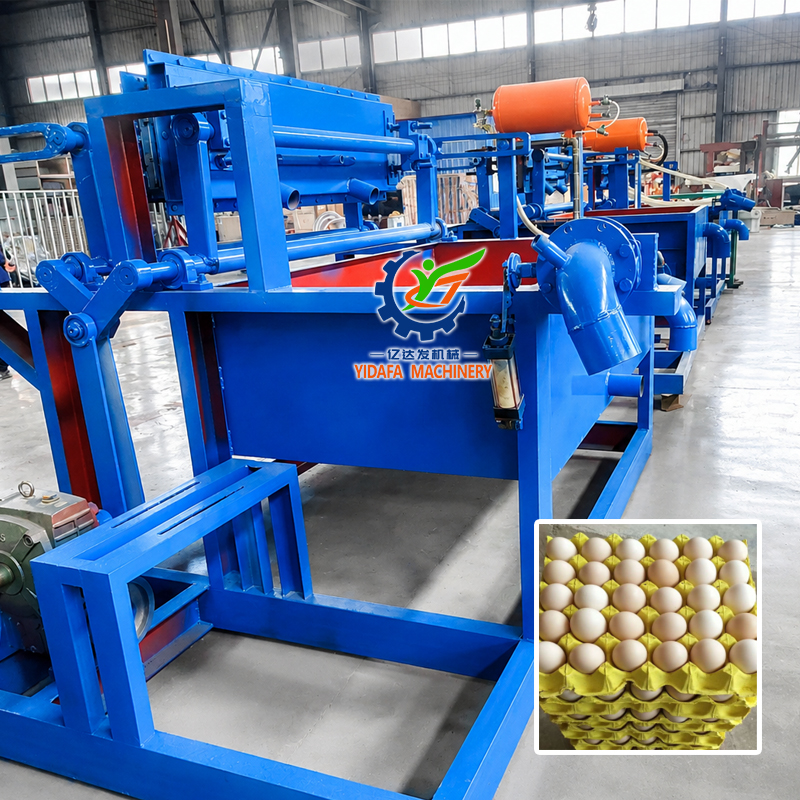
As global demand for sustainable packaging continues to grow, molded pulp products are becoming an increasingly popular alternative to traditional plastic packaging. Among these products, paper egg trays play an important role in protecting eggs during storage, transportation, and distribution. To meet the growing market demand, the Egg Tray Making Machine has become an essential investment for manufacturers seeking efficient, environmentally friendly, and cost-effective packaging production solutions.
An egg tray making machine is specially designed to convert recycled waste paper, old newspapers, cardboard, and other paper-based materials into molded pulp egg trays. Through pulping, molding, drying, and packaging processes, the production line transforms recyclable paper resources into durable packaging products with excellent cushioning and shock-absorption properties.
A modern egg tray production line integrates several processing systems to ensure stable production and consistent product quality.
Pulp Preparation System
Waste paper and other suitable raw materials are mixed with water in a hydrapulper to produce pulp. The pulp is then screened, refined, and adjusted to achieve the required consistency for molding.
Egg Tray Forming System
The prepared pulp is transferred into the forming machine. Specially designed molds use vacuum suction to form wet egg trays into the required shapes. The molding system determines product dimensions, surface quality, and production capacity.
Drying System
After molding, wet egg trays contain a considerable amount of moisture. They must pass through a drying system to remove excess water and achieve the required strength and stability. Depending on production requirements, manufacturers can select brick kilns, metal drying systems, or multi-layer drying lines.
Packaging System
Once dried, the finished egg trays are counted, stacked, and packaged for storage and transportation. Automatic stacking and packaging equipment can further improve production efficiency and reduce manual labor.
Investing in an automatic egg tray making machine offers several advantages for packaging manufacturers.
Recycled Raw Materials: Uses waste paper and other recyclable fiber materials, helping reduce dependence on virgin resources.
High Production Efficiency: Automated forming and drying systems support continuous industrial production.
Customizable Mold Design: Different molds can produce 6-cell, 10-cell, 12-cell, 15-cell, and 30-cell egg trays, as well as other molded pulp packaging products.
Reduced Labor Requirements: Automatic feeding, forming, conveying, and stacking systems help reduce manual operations.
Flexible Production Capacity: Equipment configurations can be selected according to factory size, investment budget, and market demand.
Environmentally Responsible Packaging: Molded pulp products are generally recyclable and biodegradable under appropriate conditions.
Although egg trays are the primary product, modern molded pulp production equipment can manufacture a wide range of packaging products by changing the forming molds.
Typical applications include:
Paper egg trays for poultry farms and egg distributors.
Egg cartons for supermarkets and retail packaging.
Fruit trays for apples, pears, and other agricultural products.
Industrial molded pulp protective packaging.
Cup carriers and other customized paper packaging products.
This flexibility allows manufacturers to expand their product range and explore additional business opportunities in the sustainable packaging industry.
Before purchasing an egg tray production line, investors should evaluate several important factors.
First, determine the required daily production capacity based on local market demand. Second, consider the availability and cost of waste paper or other pulp raw materials. Third, select an appropriate drying method according to local energy prices, factory conditions, and environmental requirements.
It is also important to evaluate the automation level, mold configuration, energy consumption, installation requirements, and after-sales technical support.
A professional equipment supplier should provide a complete production solution, including equipment configuration, factory layout planning, installation guidance, operator training, and technical support.
With increasing attention to environmental protection and sustainable packaging, the egg tray manufacturing industry offers promising opportunities for packaging investors and paper recycling businesses.
A properly configured egg tray making machine can help manufacturers convert waste paper into valuable molded pulp products while improving production efficiency and resource utilization. Whether establishing a small egg tray factory or expanding an existing packaging plant, choosing suitable production equipment is an important step toward long-term business development.
For manufacturers planning to enter the molded pulp packaging market, investing in reliable egg tray production technology can create new opportunities in the growing eco-friendly packaging sector.
Q1: What raw materials are used in an egg tray making machine?
Common raw materials include waste newspapers, cardboard, recycled office paper, and other suitable waste paper materials. These materials are processed into pulp before molding.
Q2: What types of products can an egg tray machine manufacture?
Depending on the mold design, the machine can produce 6-cell, 10-cell, 12-cell, 15-cell, and 30-cell egg trays, egg cartons, fruit trays, and other molded pulp packaging products.
Q3: What is the production process of an egg tray manufacturing plant?
The main production process includes pulp preparation, pulp screening, vacuum forming, wet tray transfer, drying, stacking, and packaging.
Q4: How much does an egg tray making machine cost?
The investment cost depends on production capacity, automation level, forming machine configuration, drying system, and auxiliary equipment. A customized quotation is recommended based on specific production requirements.
Q5: Is an automatic egg tray making machine suitable for small businesses?
Yes. Small and medium-sized production lines are available for startups and businesses with limited factory space. Buyers should select equipment according to their target output and available investment.
Q6: Can an egg tray production line use recycled paper?
Yes. Recycled waste paper is one of the most commonly used raw materials. Proper pulping, screening, and consistency control help ensure stable molding performance and finished product quality.
Q7: What factors affect egg tray production capacity?
Production capacity is influenced by the number of forming molds, machine operating speed, mold cavity configuration, raw material quality, drying efficiency, and working hours.
Q8: Can the egg tray making machine be customized?
Yes. Production lines can be configured according to required capacity, product specifications, factory conditions, energy sources, and automation requirements.

