
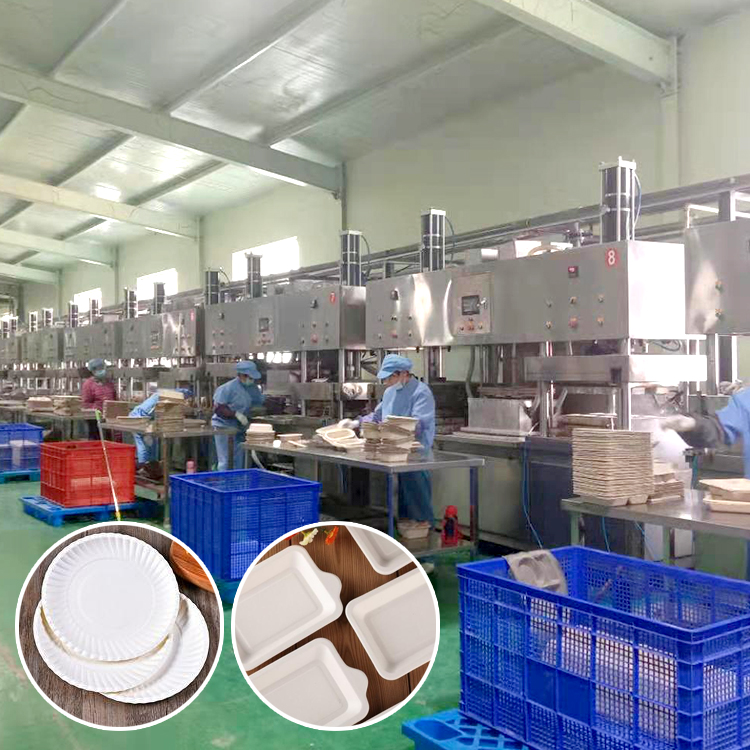
As demand for sustainable food packaging continues to grow, sugarcane pulp tableware has become an attractive alternative to conventional plastic and foam products. Made from bagasse, the fibrous residue left after sugarcane juice extraction, these products can be used to manufacture disposable plates, bowls, trays, and other molded fiber food containers.
For manufacturers planning to enter the eco-friendly packaging industry, understanding the China sugarcane pulp plate making machine cost is an important first step. China offers a wide range of pulp molding equipment, from compact semi-automatic machines to fully automatic production lines. The final investment depends on production capacity, automation level, mold configuration, drying technology, and the overall factory setup.
The price of a sugarcane pulp plate making machine is influenced by several technical and commercial factors. Buyers should evaluate the complete production system rather than comparing equipment prices alone.
Production capacity is one of the main factors affecting equipment cost. Small-scale machines may be suitable for startups or local packaging businesses, while high-capacity automatic lines are designed for manufacturers supplying wholesalers, supermarkets, catering companies, and food packaging distributors.
When evaluating capacity, buyers should confirm the expected output per hour or per day, the product type, and the number of cavities in each mold.
Semi-automatic equipment generally requires more manual handling and may have a lower initial investment. Fully automatic sugarcane pulp plate production lines can integrate pulp feeding, forming, hot pressing, trimming, and product handling, depending on the configuration.
Higher automation can improve production consistency and reduce labor requirements, but the return on investment depends on actual operating conditions.
Different plate diameters, bowl depths, tray shapes, and product designs require corresponding molds. Multi-cavity molds can increase output, while customized molds may add to the initial investment.
Manufacturers should confirm the required product dimensions, wall thickness, weight, appearance, and applicable food-contact requirements before ordering equipment.
Drying and hot pressing are essential stages in molded fiber tableware production. Equipment configurations vary according to the forming method, heating system, production speed, and product requirements.
The choice of electric, thermal oil, steam, or other heating arrangements should be evaluated based on local energy costs, available utilities, and the supplier's technical specifications.
A complete sugarcane pulp tableware production line may require more than the main forming machine. Depending on the process, supporting equipment can include:
Bagasse pulp preparation and mixing systems
Pulp storage tanks and delivery pumps
Vacuum and compressed-air systems
Forming and hot-pressing equipment
Trimming and finishing machines
Water circulation and wastewater treatment facilities
Electrical control systems and installation components
These additional requirements can significantly affect the total project budget.
There is no single standard price for every sugarcane pulp plate making machine manufactured in China. Equipment quotations vary according to the production line design, automation level, capacity, mold quantity, and included auxiliary systems.
For an accurate quotation, buyers should provide the supplier with their intended product specifications, target output, preferred automation level, and installation location.
When comparing quotations, consider the following cost categories:
| Cost category | What to check |
|---|---|
| Main production machine | Forming capacity, pressing system, and automation |
| Mold investment | Plate sizes, bowl designs, and cavity quantity |
| Pulp preparation | Pulping, mixing, storage, and delivery equipment |
| Drying and heating | Energy source, temperature control, and consumption |
| Auxiliary systems | Vacuum, air supply, water circulation, and trimming |
| Installation and commissioning | Technical support, training, and installation scope |
| Transportation and import | Packaging, freight, customs duties, and local taxes |
| Operating expenses | Labor, energy, maintenance, pulp, and packaging |
Important purchasing tip: Request an itemized quotation that clearly identifies the equipment included in the price. A low-priced forming machine may not include the complete systems needed for commercial production.
A typical bagasse-based molded fiber tableware production process involves several stages. The exact configuration depends on the raw material, product design, and selected manufacturing technology.
Step 1: Raw Material Preparation
Sugarcane bagasse is collected and prepared for pulp processing. Depending on its condition and the selected process, cleaning and additional preparation may be necessary.
Step 2: Pulping and Mixing
The prepared fibers are processed into pulp and mixed with water to achieve the required consistency. Any additives used must be compatible with the intended product and applicable food-contact regulations.
Step 3: Pulp Forming
The pulp suspension is delivered to the forming system, where specialized molds shape the fibers into plates, bowls, or other tableware products.
Step 4: Drying and Hot Pressing
The formed products undergo drying and, where required, hot pressing to remove moisture, improve rigidity, and achieve the desired surface finish and shape.
Step 5: Trimming and Quality Inspection
Excess edges are removed, and the finished products are inspected for dimensions, appearance, strength, and consistency.
Step 6: Packaging and Storage
Qualified products are counted, packaged, and prepared for delivery to food service companies, distributors, and other customers.
China has an established manufacturing sector for industrial machinery and molded fiber equipment. Buyers can compare different machine configurations, production capacities, and levels of automation to find a solution suitable for their business plans.
Potential advantages include:
Flexible equipment configurations: Production lines can be selected according to product range and capacity requirements.
Customized molds: Manufacturers can request different plate sizes, bowl shapes, and tray designs.
Integrated production solutions: Depending on the supplier, equipment packages may include pulp preparation, forming, pressing, and auxiliary systems.
Technical support: Installation guidance, operator training, and spare parts may be available according to the contract.
Scalable production planning: Buyers can evaluate whether to begin with a smaller line or invest in a more automated system.
Before placing an order, review the supplier's technical documentation, machine specifications, production references, warranty terms, and after-sales service arrangements.
The profitability of a sugarcane pulp plate manufacturing project depends on more than the purchase price of the machine. A practical financial evaluation should include both initial investment and recurring production costs.
Key indicators include:
Total equipment and installation investment
Actual saleable output per operating day
Raw material and additive costs
Electricity, steam, fuel, and water consumption
Labor, maintenance, and packaging expenses
Product selling price and market demand
Equipment utilization and product rejection rate
A simple payback estimate can be calculated as:
Estimated Payback Period = Total Initial Investment ÷ Average Monthly Net Operating Profit
This calculation is only a preliminary planning tool. Actual results depend on production efficiency, financing costs, taxes, market conditions, and other business expenses. Buyers should prepare a project-specific financial model before making an investment decision.
Selecting the right machine begins with a clear understanding of the target market. A business producing standard disposable plates may require a different configuration from a factory manufacturing compartment trays or deep food bowls.
Before requesting a quotation, determine:
The main products and their dimensions.
The required production capacity and working hours.
The level of automation preferred.
The availability and quality of sugarcane bagasse or prepared pulp.
Local energy prices and utility conditions.
Factory space, installation requirements, and environmental regulations.
The expected sales volume and target production cost.
A detailed technical discussion with the manufacturer can help identify a suitable machine configuration and avoid unnecessary investment in equipment that does not match the intended production requirements.
The cost varies according to machine capacity, automation level, mold design, drying technology, and auxiliary equipment. Buyers should request a customized quotation based on their product specifications and required production output.
Yes. With suitable molds and compatible machine configurations, a production line may manufacture plates, bowls, trays, and other molded fiber products. The available product range depends on the equipment design and mold specifications.
Sugarcane bagasse is a common raw material. Depending on the manufacturing process and product requirements, other suitable plant fibers or prepared pulp may also be used.
A fully automatic line can reduce manual handling and support higher production volumes, while a semi-automatic machine may be appropriate for smaller operations. The best option depends on budget, labor availability, target output, and expected market demand.
A complete line may include pulp preparation, mixing and storage tanks, pulp delivery systems, forming equipment, drying or hot pressing, trimming, and auxiliary utilities. The exact equipment list should be confirmed with the supplier.
Potential approaches include selecting appropriately sized equipment, optimizing mold utilization, reducing material waste, improving energy efficiency, controlling product rejection rates, and planning preventive maintenance.
Buyers should provide the desired plate or bowl dimensions, target production capacity, product types, preferred automation level, raw material information, installation country, and any special technical requirements.

